

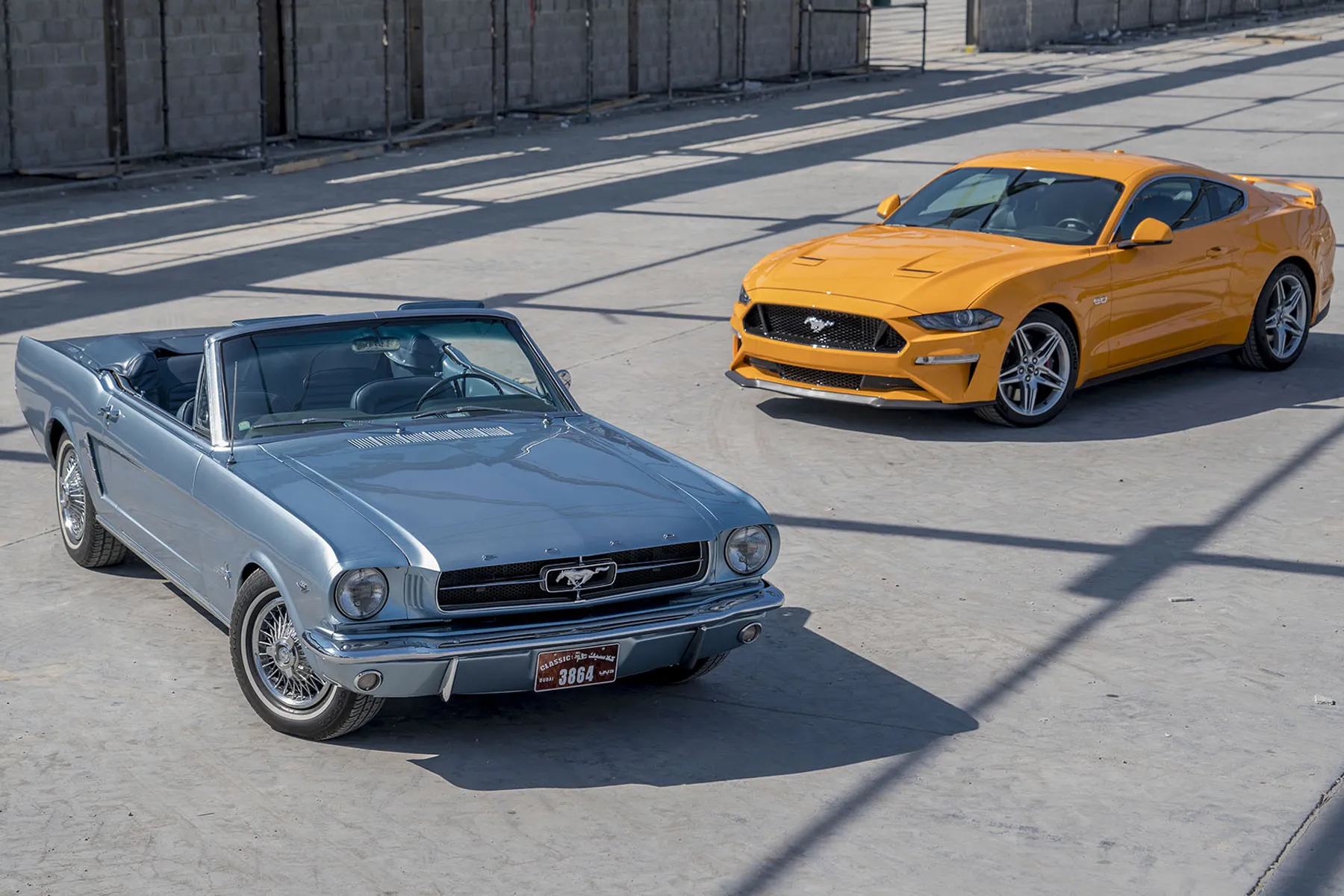
The Ford Mustang has evolved through seven distinct generations since its 1964 debut.
Gen 7 (2024–Present): The high-tech S650, featuring the track-ready Dark Horse and the 800-hp GTD.
Gen 1 (1964–1973): The original “Pony Car” icon.
Gen 2 (1974–1978): The compact “Mustang II” era.
Gen 3 (1979–1993): The long-lived Fox Body.
Gen 4 (1994–2004): The rounded SN95 and New Edge designs.
Gen 5 (2005–2014): The retro-futurist S197.
Gen 6 (2015–2023): Global expansion with independent rear suspension (S550).
If you want the short version: there have been 7 generations spanning 1964 to present day. But every one of those eras has its own story, its own fans, and its own reasons to exist. Here’s the full picture.
All Mustang Generations at a Glance
|
Generation |
Years |
Common Nickname |
Defining Feature |
|---|---|---|---|
|
1st Gen |
1964½ – 1973 |
Classic / Original |
Birth of the pony car; long hood, short deck |
|
2nd Gen |
1974 – 1978 |
Mustang II |
Controversial downsizing; Pinto platform |
|
3rd Gen |
1979 – 1993 |
Fox Body |
5.0 V8 comeback; beloved by modifiers |
|
4th Gen |
1994 – 2004 |
SN95 / New Edge |
Modernized styling; Cobra R models |
|
5th Gen |
2005 – 2014 |
S197 Retro |
Retro design revival; Shelby GT500 returns |
|
6th Gen |
2015 – 2023 |
S550 |
First IRS; global market; GT350/GT500 |
|
7th Gen |
2024 – present |
S650 / Dark Horse |
Dark Horse debut; manual comeback focus |
1st Generation (1964½-1973) – The Original Pony Car
The Mustang didn’t just start a model line – it started an entire category of car. Ford sold over 418,000 units in the first year alone, a record that stunned the industry. The base 2.8L inline-six was honest transportation, but the 4.7L (289) and later 7.0L (428) V8 options turned it into a street legend.
The 1968 Mustang GT fastback – driven by Steve McQueen in Bullitt – became the most famous Mustang in cinema history. The Mach 1, Boss 302, and Boss 429 followed, each pushing performance further. By 1973, displacement reached its peak before federal regulations changed everything.
2nd Generation (1974-1978) – The Controversial Era
The oil crisis hit hard, and Ford responded by shrinking the Mustang significantly. Built on the Pinto platform and shedding hundreds of pounds, the Mustang II horrified purists but actually sold reasonably well – over 385,000 units in 1974 alone. The V8 was gone initially (returned briefly in 1975), and handling took priority over power.
Time has been somewhat kinder to the Mustang II than its reputation suggests. A Cobra II package added sporty looks, and the King Cobra trim of 1978 was genuinely handsome. But most enthusiasts still consider this the generation they’d rather forget.
3rd Generation (1979-1993) – Fox Body Renaissance
The Fox Body Mustang is arguably the most modified platform in American history. Built on Ford’s Fox unibody architecture, it was lighter, more rigid, and – crucially – came back with a proper 5.0L V8 in 1982. That engine, in naturally aspirated and later modified form, became the heartbeat of the American tuner scene.
The SVT Cobra and 1993 Cobra R represent the high-water marks of this era. But the real legacy of the Fox Body is in garages across America, where these cars have been built, rebuilt, boosted, and track-prepped by generations of enthusiasts who loved that the platform was endlessly adaptable.
4th Generation (1994-2004) – SN95 and New Edge
Ford gave the Mustang its first major visual overhaul in 15 years with the SN95 in 1994. The rounded, contemporary styling divided opinion, but the 4.6L modular V8 in GT and Cobra forms gave it genuine performance credibility. The 1995 and 2000 Cobra R models – track-only, no radio, racing seats, enormous wings – showed Ford was serious about performance again.
The 1999 ‘New Edge’ facelift sharpened the styling with creased lines and angular headlights. The 2003-2004 Cobra with its supercharged 4.6L producing 390hp (and famously closer to 420 on the dyno) was the most powerful factory Mustang to that point.
5th Generation (2005-2014) – Retro Revival
When the 2005 Mustang arrived with its deliberately retro long-hood fastback styling, it caused a sensation. Ford had done its homework – the S197 was built on a modern platform, handled properly, and finally looked like it deserved to be called a Mustang again. It sold extremely well.
The real highlight of this era was the return of the Shelby GT500 in 2007, and its evolution to a supercharged 5.8L V8 producing 662hp in 2013. The Boss 302 of 2012-2013 was arguably the best driver’s Mustang the fifth generation produced – focused, rev-happy, and genuinely exciting.
6th Generation (2015-2023) – Independent Rear Suspension Arrives
The 2015 Mustang was the biggest technical leap since the Fox Body. It finally got independent rear suspension (something purists had argued about for decades), a turbocharged 4-cylinder EcoBoost option, and – for the first time – it went on sale globally. The Mustang was now a world car.
This generation’s high points are extraordinary: the GT350 with its 8,250 rpm flat-plane crank V8, the GT500 with 760hp and a supercharger you could hear three blocks away, and the Mach 1 bringing back a beloved nameplate. The 2021 Mach-E (the electric SUV) caused controversy by using the Mustang name – purists were… not thrilled.
7th Generation (2024-Present) – The Dark Horse Era
The 2024 Mustang brought a significant exterior refresh, a new instrument cluster design, and – most notably – the debut of the Dark Horse model. The Dark Horse is a GT500-lite: a 500hp naturally aspirated 5.0 Coyote V8 with a 6-speed Tremec manual, MagneRide suspension, and Brembo brakes as standard. It’s designed specifically for track driving while remaining street-legal.
The 7th gen also doubled down on the manual transmission with an active rev-matching system and a stronger focus on driver engagement. In an era when most performance cars are going automatic or electric, Ford’s commitment to the manual gearbox feels like a genuine statement.
Most Iconic Mustang of Each Generation
|
Generation |
Most Iconic Model |
Why |
|---|---|---|
|
1st Gen |
1968 GT390 Fastback (Bullitt) |
Cinema legend; peak classic muscle proportions |
|
2nd Gen |
1976 Cobra II |
Best styling of a difficult era |
|
3rd Gen |
1993 SVT Cobra |
Final and finest Fox Body performance Mustang |
|
4th Gen |
2003-04 Terminator Cobra |
Supercharged; made more power than rated |
|
5th Gen |
2013 Shelby GT500 |
662hp from the factory; peak muscle car of its era |
|
6th Gen |
GT350R |
Flat-plane V8; 8,250 rpm redline; track-focused masterpiece |
|
7th Gen |
Dark Horse |
500hp NA V8 + Tremec manual; driver-focused return to form |
The Mustang’s seven generations tell the story of American car culture itself – optimism, crisis, reinvention, excess, refinement, and comeback. Whatever era you grew up with, there’s a version of this car that probably got into your blood. That’s what 60 years of production buys you.
