

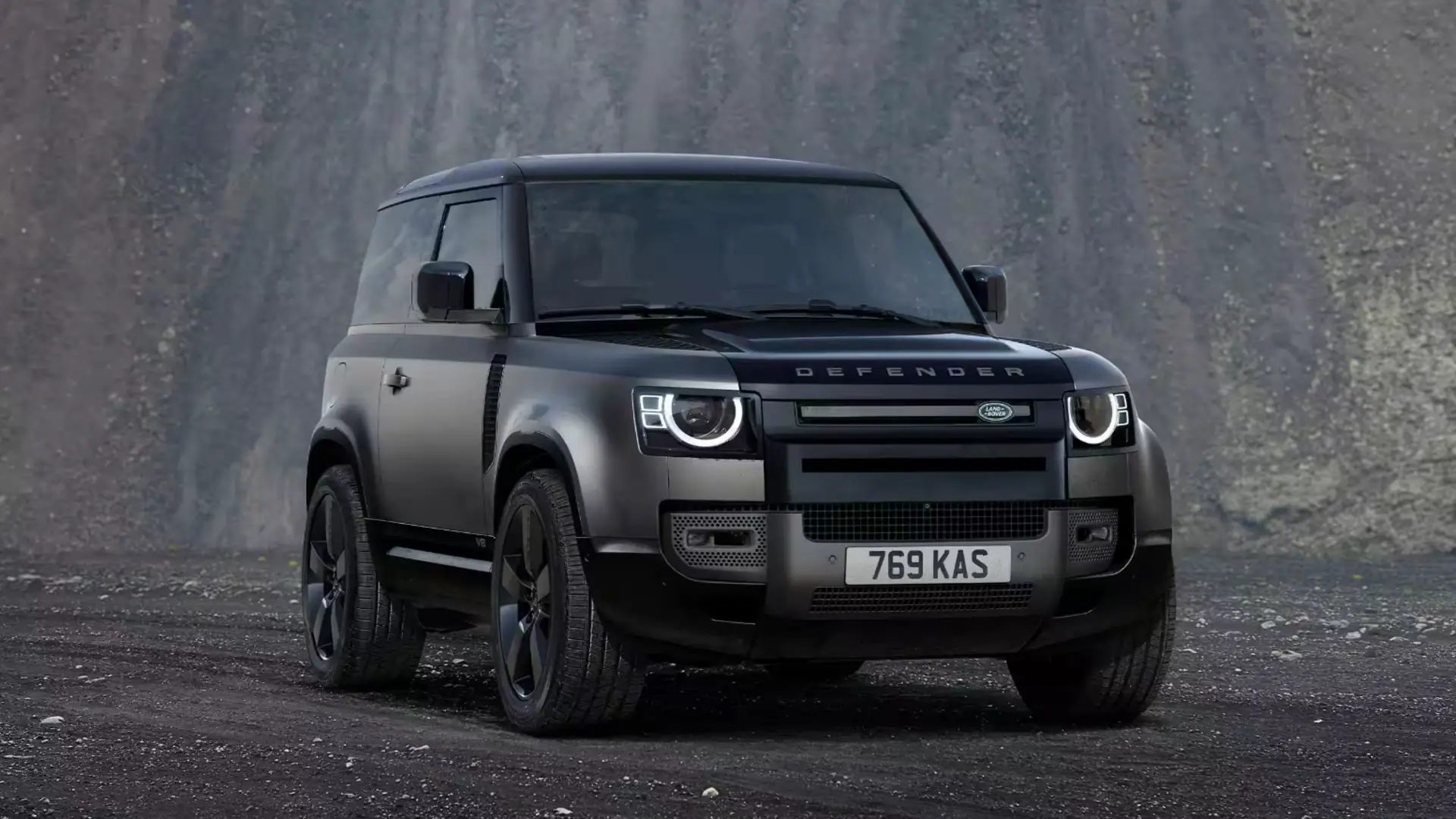
The “baby defender“ traditionally refers to the Defender 90, the nimble three-door variant that starts at roughly $56,400. However, for 2026, Land Rover has officially confirmed a smaller, more affordable “Defender Sport” (often called the 80) is in development. This new entry-level model will be fully electric, offering the rugged, squared-off silhouette of its big brother in a more urban-friendly size, expected to start around $45,000 to compete directly with the Ford Bronco Sport and Rivian R2.
Despite its smaller footprint, the Defender 90 is not a watered-down version. It gets the same chassis, the same air suspension, the same Terrain Response system, and the same powertrain options as the 110. What you give up is rear seat space and cargo room – what you gain is one of the most characterful and capable SUV driving experiences available at any price.
What Is the Baby Defender?
‘Baby Defender’ is a popular nickname for the Defender 90, used to distinguish it from the larger Defender 110 (5-door) and the Defender 130 (extended wheelbase). Land Rover introduced the current-generation Defender in 2020, and the 90 body style arrived shortly after as a more driver-focused, sportier alternative.
It seats up to six in the standard layout – two in front and four in the rear – though rear legroom is genuinely tight for adults on longer journeys. For shorter trips and off-road adventures, it is perfectly comfortable.
Land Rover Defender 90 – Key Specs
|
Specification |
Detail |
|
Body Style |
3-door SUV (short wheelbase) |
|
Seating Capacity |
Up to 6 |
|
Engine Options |
2.0L P300 Petrol / 3.0L P400 Mild Hybrid / 5.0L P525 V8 |
|
Base Power (P300) |
296 hp |
|
V8 Power (P525) |
518 hp |
|
0-60 mph (P300) |
7.0 seconds |
|
0-60 mph (P525 V8) |
4.9 seconds |
|
Off-Road Ground Clearance |
291 mm (11.5 inches) |
|
Wading Depth |
900 mm (35.4 inches) |
|
Starting Price (US) |
~$55,300 |
|
V8 Price (US) |
~$130,000+ |
Design – Classic Looks, Modern Engineering
The Defender 90 is a striking car in person – shorter and squarer than almost anything else on the road, with exposed door hinges, an external spare wheel, and a rear-opening tailgate that still feels delightfully old-school. Land Rover’s designers managed to honour the original Defender’s geometric honesty while building something that is undeniably modern.
Available in a wide range of colours including Sedona Red, Pangea Green, Fuji White, and the popular Gondwana Stone, the 90 also accepts a huge array of factory accessories – roof racks, side steps, snorkels, and body armour packs – that let owners personalise them heavily without voiding any warranties.
Interior and Technology
PIVI Pro Infotainment
Land Rover’s PIVI Pro system sits on a 11.4-inch curved touchscreen and is one of the better infotainment systems in the premium off-road segment. It updates over the air, responds quickly, and integrates navigation with off-road data including pitch, roll angle, and terrain information – genuinely useful when the going gets rough.
Seating Configuration
The standard Defender 90 layout puts two seats in front and four in the rear bench. An optional jump seat configuration can add a seventh seat, though practically this is very cramped and best treated as an emergency option. The front seats are excellent – supportive, well bolstered, and available with heating and cooling on upper trims.
Off-Road Capability – Is It Still a Real Defender?
Absolutely. The Defender 90 has more genuine off-road capability than most people will ever use. Terrain Response 2 allows the driver to select optimised settings for mud, sand, rock, grass, or snow with a single dial turn. The air suspension lifts the body to maximise clearance when needed, and the optional Wade Sensing system monitors water depth when crossing rivers.
On steep descents, the Hill Descent Control manages speed precisely without driver input. In real-world testing, the Defender 90 has proven capable of terrain that would stop most other premium SUVs – it earns its Defender name genuinely, not cosmetically.
Baby Defender vs. Full Defender 110
|
Feature |
Defender 90 (Baby) |
Defender 110 (Standard) |
|
Doors |
3 |
5 |
|
Wheelbase |
2,587 mm |
3,022 mm |
|
Seating |
Up to 6 |
Up to 7 |
|
Cargo Volume (seats up) |
295 litres |
857 litres |
|
Starting Price (US) |
~$55,300 |
~$57,300 |
|
Length |
4,323 mm |
4,758 mm |
|
Best For |
Sporty driving, style, off-road |
Family use, practicality, travel |
Price and Available Variants
The Defender 90 is available in four trim levels in most markets: Standard, S, SE, and X. The base model at $55,300 is the entry point, while the fully loaded X trim with the 3.0-litre mild hybrid easily crosses $85,000 before options.
The V8 First Edition – packing 518 hp from Land Rover’s supercharged 5.0-litre V8 – is available at around $130,000 and is one of the most dramatic factory 4x4s you can currently buy.
Pros and Cons
|
Pros |
Cons |
|
Genuinely capable off-road hardware |
Tight rear passenger space |
|
Distinctive, iconic design |
Land Rover reliability concerns linger |
|
Excellent PIVI Pro infotainment |
Expensive options list inflates price quickly |
|
Strong engine range including V8 |
Fuel economy is poor across all trims |
|
Huge personalisation options |
Cargo space compromised vs 110 |
|
V8 variant is genuinely thrilling |
Service costs are premium-level |
