

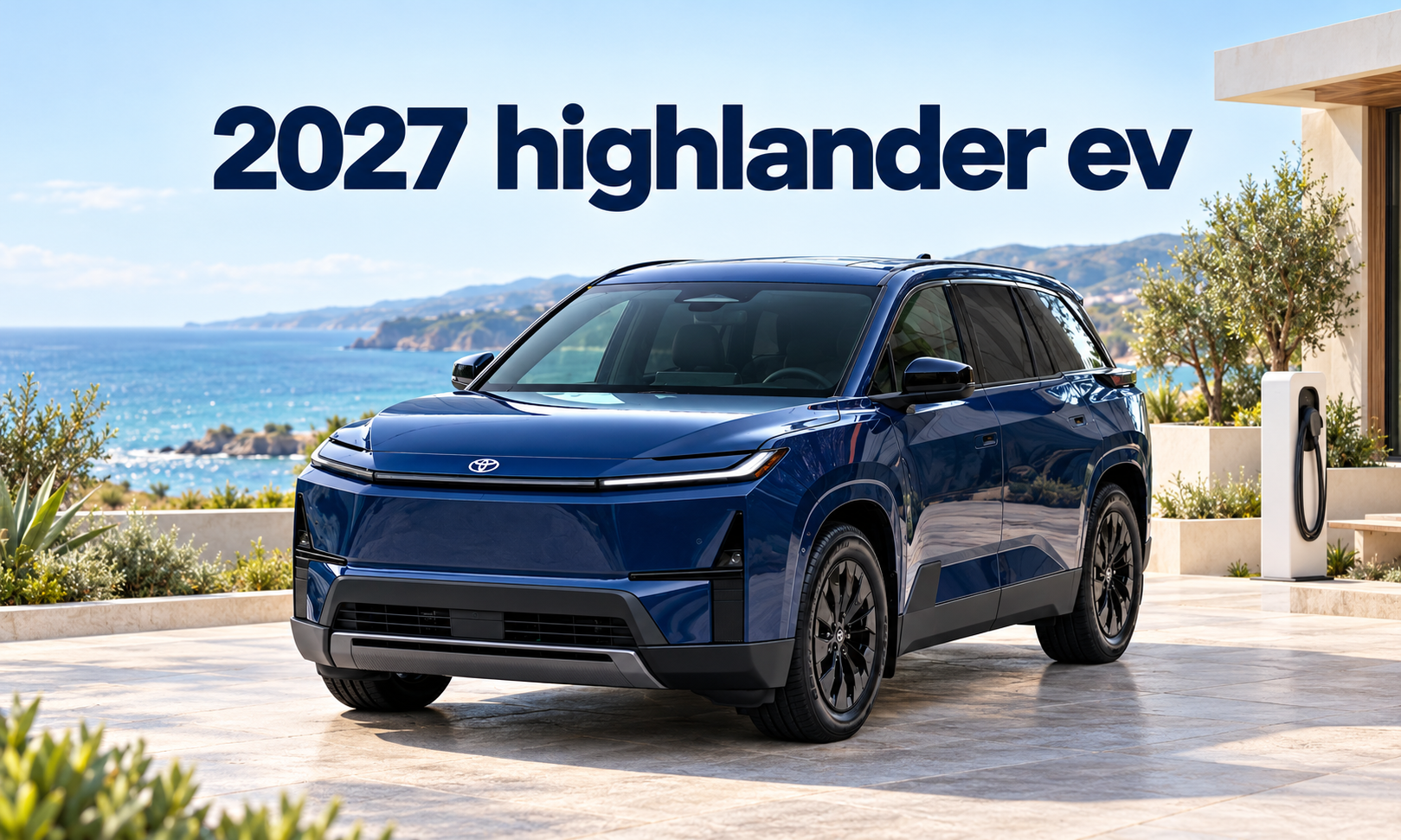
The 2027 highlander ev was originally introduced as Toyota’s next-generation three-row electric SUV for the U.S. market, with front- or all-wheel drive, two battery choices, fast charging, seating for up to seven, and an early range estimate of as much as 320 miles. Since that reveal, however, Toyota has revised the launch plan and now officially identifies the vehicle as the 2028 Toyota Highlander.
That does not mean the electric Highlander has disappeared. Instead, the model-year designation and timing have shifted. As of October 2026, Toyota says the XLE AWD and Limited AWD versions with the 95.8-kWh battery are expected to begin U.S. sales in early 2027 as 2028 model-year vehicles, while the XLE FWD version with the 77.0-kWh battery is expected in mid-2027. For shoppers, this makes the Highlander EV story a little confusing, but the vehicle itself remains one of Toyota’s most important upcoming electric SUVs.
Is There Still a 2027 Toyota Highlander EV?
The short answer is that the vehicle announced as the 2027 Highlander EV has been moved to the 2028 model year. Toyota originally revealed the all-electric Highlander in February 2026 and said sales would begin in late 2026 and continue into early 2027. By September 25, 2026, Toyota had updated its official materials to identify the same new generation as the 2028 Highlander.
For shoppers, the practical takeaway is simple. Searching for the 2027 Highlander EV will still lead to useful early information, photos, and specifications, but the production vehicle expected to reach U.S. customers will now wear a 2028 model-year designation.
Toyota’s most current manufacturer information is available in the official 2028 Toyota Highlander release, which reflects the revised launch timing and latest range estimates.
When Will the Electric Highlander Go on Sale in the U.S.?
Toyota’s current schedule separates the launch by drivetrain and battery configuration. The first versions expected to reach customers are the XLE AWD and Limited AWD models fitted with the larger 95.8-kWh battery. Toyota says those models are expected to begin sales in early 2027.
The XLE FWD version with the smaller 77.0-kWh battery is expected in mid-2027. Toyota has not announced a specific on-sale day, and pricing is also still pending.
Earlier plans had targeted late 2026 for the start of sales. The revised schedule means shoppers who were waiting for a 2027-model Highlander EV should now plan around a 2028 model-year vehicle arriving during calendar year 2027.
What Are the Latest Highlander EV Specs?
| Specification | Latest U.S. Information |
| Current official model year | 2028 Toyota Highlander |
| Original announced model year | 2027 Toyota Highlander |
| Powertrain | Battery electric |
| Grades | XLE and Limited |
| Drive layouts | FWD or AWD on XLE; AWD standard on Limited |
| Battery choices | 77.0 kWh or 95.8 kWh depending on trim and drivetrain |
| FWD output | 221 hp and 198 lb-ft |
| AWD output | 338 hp; 198 lb-ft front motor and 125 lb-ft rear motor |
| Maximum manufacturer-estimated range | 315 miles with 95.8-kWh AWD configuration |
| Charging port | NACS |
| DC fast charging | About 10% to 80% in around 30 minutes under ideal conditions |
| Seating | Up to 7 passengers |
| Cargo behind third row | 15.9 cu ft |
| Cargo with third row folded | 45.6 cu ft |
| U.S. assembly | Georgetown, Kentucky |
How Much Range Will the Highlander EV Have?
Range depends on the drivetrain and battery pack. Toyota currently lists four main configurations. The front-wheel-drive XLE with the 77.0-kWh battery has a manufacturer-estimated 287-mile range. The XLE AWD with the same 77.0-kWh battery is estimated at 270 miles.
Moving to the 95.8-kWh battery raises the estimate to 315 miles for both the XLE AWD and Limited AWD. This is slightly lower than the 320-mile figure Toyota originally announced for the 2027 version of the vehicle.
| Configuration | Battery | Drive | Estimated Range |
| XLE FWD | 77.0 kWh | FWD | 287 miles |
| XLE AWD | 77.0 kWh | AWD | 270 miles |
| XLE AWD | 95.8 kWh | AWD | 315 miles |
| Limited AWD | 95.8 kWh | AWD | 315 miles |
These are manufacturer estimates rather than final EPA ratings. Actual range can vary significantly with highway speed, temperature, cabin heating or cooling, wheel size, cargo load, driving style, and battery condition.
How Fast Will the Highlander EV Charge?
Toyota says the electric Highlander will use the North American Charging System, commonly called NACS. That gives the SUV access to a large and growing network of compatible DC fast chargers in the United States.
Under ideal conditions, Toyota says the battery can charge from 10 percent to 80 percent in around 30 minutes on a DC fast charger. The vehicle will also support Level 1 and Level 2 AC charging, and Toyota plans to include a dual-voltage 120-volt and 240-volt charging cable.
Battery preconditioning is also part of the package. This system can warm or cool the battery before fast charging so the pack is closer to its optimal charging temperature. Toyota also lists Plug & Charge capability on compatible networks, which can reduce the need to manually authenticate through separate charging apps.
Drivers comparing home and public charging options can review the U.S. Department of Energy’s Alternative Fuels Data Center electric-vehicle charging resources for general information about charging levels and infrastructure.
How Powerful Is the Electric Highlander?
Front-wheel-drive Highlander models use a single electric motor and produce 221 total system horsepower with 198 lb-ft of torque. All-wheel-drive models add a rear motor and raise total system output to 338 horsepower.
Toyota has not published an official 0-to-60-mph time. However, instant electric-motor torque should make the AWD version feel considerably quicker at low speeds than many traditional three-row family SUVs.
AWD versions also add Multi-Terrain Select and Crawl Control. These features are intended to improve control on low-traction surfaces and during slow-speed driving, although the Highlander remains a family-focused crossover rather than a dedicated off-road SUV.
How Big Is the New Highlander EV?
The electric Highlander is larger than the outgoing Highlander in several key dimensions. Toyota lists an overall length of 198.8 inches, width of 78.3 inches, height of 67.3 inches, and wheelbase of 120.1 inches.
The longer wheelbase is particularly important for an electric three-row SUV because it creates more room for the battery beneath the floor while also helping improve passenger space. Toyota says the third row is designed to accommodate two adults, and second-row captain’s chairs are standard. An available second-row bench seat on the XLE AWD expands capacity to seven passengers.
How Much Cargo Space Does It Have?
Toyota lists 15.9 cubic feet of cargo space with the third row in use. Folding the third row increases available cargo room to 45.6 cubic feet.
That should make the Highlander useful for groceries, luggage, sports equipment, and family travel, although shoppers who routinely need maximum cargo space with all three rows occupied should compare the measurements with larger three-row EVs before buying.
What Technology Will Come Standard?
The cabin is built around a 14-inch touchscreen and a 12.3-inch digital driver display. Toyota retains physical buttons for important climate functions, which should make the interface easier to use while driving than systems that move nearly every control onto a touchscreen.
Wireless Apple CarPlay and Android Auto are standard, along with simultaneous dual-phone Bluetooth connectivity. Toyota also includes multiple USB-C ports, a dual wireless charging tray in the center console, customizable ambient lighting with 64 color choices, and a standard built-in Drive Recorder that uses exterior cameras to save short video clips.
An available head-up display and upgraded audio equipment further distinguish higher-spec versions. Toyota also plans connected services that allow owners to check charging status, manage charging schedules, and locate charging stations through the Toyota app.
What Is Vehicle-to-Load and Why Does It Matter?
The new Highlander introduces vehicle-to-load capability for a Toyota sold in the United States. With the required accessories, the battery can provide electricity to external devices.
That could be useful at campsites, tailgate events, outdoor work areas, or during a household power interruption. The feature does not automatically mean every Highlander can power an entire house without additional equipment, so buyers should review Toyota’s final accessory and installation requirements when they become available.
What Safety Features Will the Highlander EV Include?
Toyota says the new Highlander will come with Toyota Safety Sense 4.0. Standard features include automatic emergency braking and pedestrian detection. It also includes full-speed adaptive cruise control, lane-departure alert with steering assist, automatic high beams, and lane-tracing assist.
Toyota also lists blind-spot monitoring with rear cross-traffic alert, front and rear parking assist with automatic braking, a rear-seat reminder, and a backup camera with dynamic guidelines as standard convenience and safety equipment.
Because independent crash-test ratings may not be available before the vehicle reaches dealerships, shoppers should check the National Highway Traffic Safety Administration vehicle safety ratings once U.S. testing is published.
Where Will the Highlander EV Be Built?
The electric Highlander will be assembled at Toyota Motor Manufacturing Kentucky in Georgetown. Toyota also says its battery modules will be assembled in the United States using production from its battery plant in Liberty, North Carolina, plus a supplier partner.
This is significant because the Highlander will be Toyota’s first battery-electric vehicle assembled in America and its first three-row battery-electric model for the U.S. market.
How Does It Compare With the Previous Highlander?
The fifth-generation electric Highlander represents a major break from the previous model. The outgoing Highlander offered gasoline and hybrid powertrains, while the new version is built around a battery-electric layout. The new SUV is also longer, wider, and has a much longer wheelbase, creating more room for passengers and the underfloor battery.
The electric model is also more technology-focused, with a larger infotainment display, a fully digital instrument cluster, built-in dashcam functionality, NACS charging, battery preconditioning, and vehicle-to-load capability.
The trade-off is that ownership now depends on charging access. Buyers who frequently take long road trips should consider charging availability along their usual routes, while homeowners who can install Level 2 charging may find day-to-day use much easier.
Will the Highlander EV Compete With the Kia EV9 and Hyundai Ioniq 9?
Yes. In the U.S. market, the Highlander will enter a still-small group of mainstream three-row electric SUVs. The Kia EV9 and Hyundai Ioniq 9 are obvious rivals because they combine three-row seating, family-oriented interiors, and long-range electric powertrains.
Toyota’s biggest strengths may be brand familiarity, its dealer network, the availability of front- and all-wheel-drive versions, and the convenience of a native NACS charging port. The final comparison will depend heavily on pricing, real-world charging speed, EPA-certified range, ride quality, third-row comfort, cargo space, and towing capability.
Toyota has not yet released every final specification, including complete towing and payload figures. Shoppers should avoid assuming the electric Highlander will match the towing capability of previous gasoline models until Toyota publishes the official limits.
How Much Will the Highlander EV Cost?
Toyota has not announced official U.S. pricing for the revised 2028 Highlander. Earlier estimates placed the originally announced 2027 model in the mid-$50,000 range, but those figures were not official manufacturer pricing.
The final MSRP will matter because three-row electric SUVs can become expensive quickly when larger batteries, all-wheel drive, premium interior features, larger wheels, and driver-assistance technology are added.
Buyers should also compare the full ownership cost rather than MSRP alone. Home-charger installation, local electricity rates, insurance, registration fees, tire replacement costs, public fast-charging prices, and available federal or state incentives can all change the real cost of ownership.
Which Highlander EV Version Could Make the Most Sense?
For drivers who prioritize efficiency and do not need all-wheel drive, the XLE FWD may be the logical starting point. Its 77.0-kWh battery is paired with a 287-mile manufacturer-estimated range, which is higher than the estimate for the small-battery AWD version.
The 95.8-kWh XLE AWD may offer the strongest balance for buyers who want all-wheel drive and maximum range. Toyota currently estimates 315 miles for that configuration, the same as the Limited AWD with the large battery.
The Limited will appeal more to shoppers who want premium equipment and standard AWD. However, the XLE could provide better value if it includes the larger battery without forcing buyers into the top trim.
Who Should Consider Waiting for the Electric Highlander?
The new Highlander may be worth waiting for if you want a Toyota three-row SUV but are ready to move away from gasoline. It is especially relevant for households with reliable home charging, predictable daily mileage, and enough flexibility to plan fast-charging stops on longer trips.
Families who live in apartments without dependable charging access, regularly tow heavy trailers, or drive long distances through areas with limited charging infrastructure may want to compare the EV with hybrid alternatives before deciding.
It is also reasonable to wait for independent road tests. Real-world highway range, winter efficiency, charging curves, third-row comfort, and ride quality cannot be fully judged from manufacturer specifications alone.
Frequently Asked Questions About the 2027 Highlander EV
Is the 2027 Highlander EV canceled?
The electric Highlander is not canceled. Toyota has changed the model-year designation to 2028 and revised the U.S. launch timing.
When will the electric Highlander be available?
Toyota currently expects the 95.8-kWh XLE AWD and Limited AWD to begin sales in early 2027. The XLE FWD with the 77.0-kWh battery is expected in mid-2027.
What is the maximum range?
Toyota’s current maximum manufacturer estimate is 315 miles for XLE AWD and Limited AWD versions equipped with the 95.8-kWh battery.
Will the Highlander EV use Tesla-style charging?
Yes. Toyota says the vehicle will use a native NACS charging port, giving it access to compatible NACS DC fast-charging stations.
How many people can it seat?
The Highlander will seat up to seven when equipped with the available second-row bench seat. Most configurations use second-row captain’s chairs and seat six.
How much horsepower does it have?
The front-wheel-drive version is rated at 221 horsepower. All-wheel-drive versions are rated at 338 total system horsepower.
Will it be made in the United States?
Yes. Toyota says the new electric Highlander will be assembled in Georgetown, Kentucky, with battery modules sourced from U.S. production.
Has Toyota announced the price?
No. Official U.S. MSRP has not yet been announced and is expected closer to the on-sale date.
Final Thoughts
The 2027 Highlander EV story has changed, but the vehicle itself remains very much alive. Toyota first introduced the next-generation Highlander as a 2027 electric SUV, then shifted it to the 2028 model year as the U.S. launch timetable moved into 2027.
The latest version still offers the core features that made the original reveal important: three-row seating, up to seven-passenger capacity, a choice of front- or all-wheel drive, two battery sizes, a native NACS port, around 30-minute 10-to-80-percent fast charging under ideal conditions, and up to 315 miles of manufacturer-estimated range.
For U.S. buyers, the biggest unanswered questions are now price, final EPA ratings, towing capability, real-world charging performance, and how quickly Toyota can supply vehicles after production begins. Until those details arrive, the most important thing to remember is that the SUV many shoppers still call the 2027 Highlander EV is now officially headed to market as the 2028 Toyota Highlander.
This article reflects U.S.-market information available on October 3, 2026. Toyota originally announced the electric Highlander as a 2027 model and later updated it to the 2028 model year. Range figures are manufacturer estimates and may change when final EPA ratings are published.
