

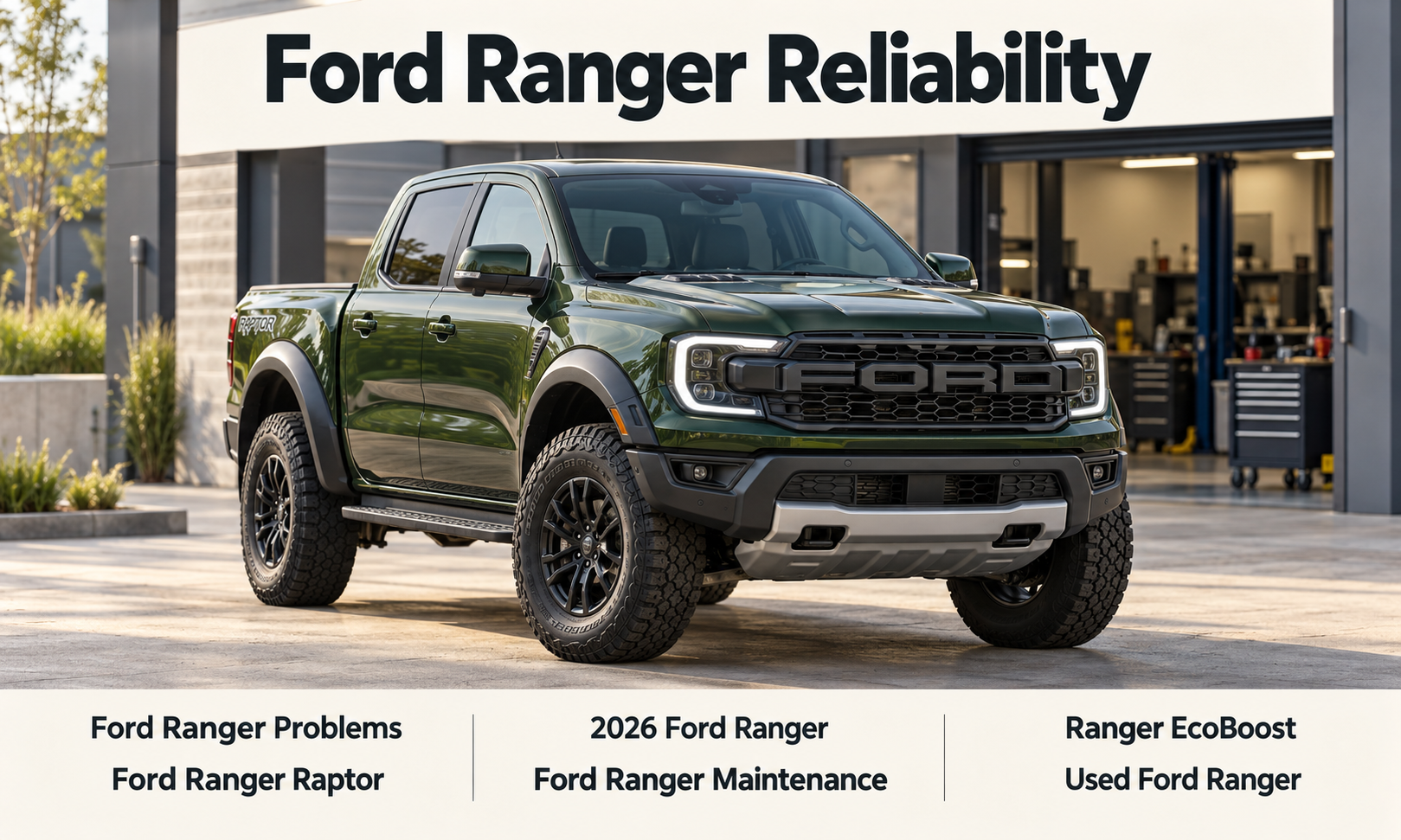
If you are researching ford ranger reliability, the most useful answer is not a simple good-or-bad rating. The current Ranger lineup combines proven EcoBoost engines, a 10-speed automatic transmission, body-on-frame construction, available four-wheel drive, and increasingly complex electronics. That mix can make the truck durable and capable, but long-term ownership still depends heavily on maintenance, use, modifications, towing, off-road driving, climate, and how quickly small problems are addressed.
For U.S. shoppers, the 2026 Ford Ranger is still relatively early in its current generation, so there is not yet a decade of owner data for this exact version. However, current long-term testing, Ford’s maintenance guidance, warranty coverage, and federal recall information provide a useful picture of what buyers should watch.
Is the Ford Ranger Reliable in 2026?
So far, the strongest current evidence is encouraging but incomplete. Car and Driver’s long-term 2026 Ranger Raptor had accumulated 20,534 miles by its September 2026 update. At that point, the publication listed $0 in repairs and $0 in normal-wear expenses, with $196 in service costs. That is a positive early result, especially because the truck had been used for daily driving, long highway trips, heavy overland travel, dirt roads, rough terrain, and an 8,000-mile trip into northern Canada.
The same truck was not completely issue-free. Staff reported one instance in which the electronic rear differential failed to unlock until the ignition was cycled, one brief limp-mode event after hard acceleration, an intermittent blind-spot and cross-traffic sensor issue, and a coolant top-up at 9,111 miles. No repair was ultimately required for the drivetrain incidents by the 20,000-mile service visit.
That distinction matters. A long-term test of one vehicle can reveal useful patterns, but it cannot establish the reliability of every Ranger sold in the United States. It is better used as a real-world case study than as a final reliability verdict.
What Does the Current Long-Term Ranger Raptor Test Show?
| Long-Term Test Item | Reported Result | Why It Matters |
| Mileage | 20,534 miles | Enough to show early durability, but still far from full vehicle life |
| Repairs | $0 | No paid mechanical repair reported through the update |
| Normal wear | $0 | No wear-item expense reported at that point |
| Service | $196 | Includes routine dealer maintenance |
| Coolant | Top-up at 9,111 miles | Worth monitoring fluid levels between services |
| Electronic rear differential | One unlock glitch | Resolved after ignition cycle and drive-mode change |
| Transmission / engine event | One brief limp-mode episode | Dealer found no related fault at 20,000-mile service |
| Driver-assistance sensors | Intermittent blind-spot / cross-traffic interruption | Shows electronics can create ownership annoyances even without a major repair |
Which Ford Ranger Engines Are Available, and Does That Affect Reliability?
The 2026 Ranger is offered with three turbocharged EcoBoost engines in the U.S. market. Regular XL, XLT, and Lariat models use the 2.3-liter four-cylinder as the standard engine, while a 2.7-liter V6 is available on XLT and Lariat models with four-wheel drive. The Ranger Raptor uses a 3.0-liter twin-turbo V6 rated at 405 horsepower and 430 lb-ft of torque.
All three engines use forced induction and modern electronic controls, so maintenance quality matters. Turbocharged engines place greater importance on correct oil specification, proper oil level, cooling-system health, and allowing warning lights or unusual noises to be diagnosed rather than ignored.
| Engine | Output | Where You Find It | Ownership Consideration |
| 2.3L EcoBoost I-4 | 270 hp / 310 lb-ft | Standard on XL, XLT, Lariat | Simplest Ranger powertrain choice and widely used in Ford products |
| 2.7L EcoBoost V6 | 315 hp / 400 lb-ft | Available on XLT and Lariat 4×4 | More torque and towing flexibility, with additional turbo/V6 complexity |
| 3.0L EcoBoost V6 | 405 hp / 430 lb-ft | Ranger Raptor | Highest performance, more specialized hardware, and potentially higher replacement costs |
For current specifications and trim information, buyers can review the official 2026 Ford Ranger model pages.
Is the Ford Ranger 10-Speed Automatic a Reliability Concern?
Every 2026 Ranger uses a 10-speed automatic transmission. It is not useful to assume that every truck with a 10-speed will develop problems, but buyers should pay attention to shift quality during a test drive and throughout ownership.
Watch for repeated harsh engagement, delayed shifts, unusual slipping, warning messages, or behavior that is clearly different from the truck’s normal calibration. An occasional firm shift during a cold start or aggressive driving is not automatically evidence of a defect, but repeatable symptoms deserve diagnosis, especially while the vehicle is within warranty.
The long-term Ranger Raptor mentioned earlier had one brief limp-mode event after hard acceleration in a manually selected gear. The condition cleared quickly, and the dealer did not find a related issue at the later service visit. That single incident is worth noting, but it is not enough to conclude that the transmission itself is unreliable.
How Often Should a Ford Ranger Be Serviced?
Ford uses an Intelligent Oil-Life Monitor rather than one fixed oil-change mileage for every driver. According to the 2026 U.S. Ranger owner’s manual, the oil-change interval can be as long as one year or 10,000 miles depending on use. Once the oil-change message appears, Ford says the service should be completed within two weeks or 500 miles.
If the oil-life system becomes inoperative or is reset incorrectly, Ford recommends using six months or 5,000 miles from the last oil change as the fallback interval. The manual also warns that high engine speeds, heavy loads, engine braking, hard cornering, track use, and off-road driving can increase oil consumption.
| Maintenance Item | Current Ford Guidance | Reliability Benefit |
| Engine oil and filter | Follow Intelligent Oil-Life Monitor; never exceed 1 year or 10,000 miles | Protects turbochargers, bearings, timing components, and internal engine surfaces |
| After oil-change alert | Complete service within 2 weeks or 500 miles | Prevents prolonged operation beyond calculated oil life |
| If oil-life monitor is unavailable | Use 6 months or 5,000 miles from the last oil change | Provides a conservative fallback schedule |
| Fluid levels | Check regularly, especially with towing or off-road use | Can catch coolant or oil loss before overheating or engine damage |
| Severe use | Expect more frequent inspections and potentially shorter service intervals | Heavy loads, dust, heat, and off-road use accelerate wear |
Owners who want the exact maintenance schedule for their truck should use Ford’s 2026 Ranger U.S. Owner’s Manual and Scheduled Maintenance section, because intervals can vary with operating conditions.
Does Off-Road Driving Change Ford Ranger Reliability?
Yes, because off-road use changes the type of stress placed on the truck. Dust, mud, deep water, repeated suspension impacts, low-speed high-load driving, tire damage, and underbody contact can all increase inspection and maintenance needs.
The Ranger Raptor is engineered specifically for demanding terrain, but even specialized components are not maintenance-free. Car and Driver’s long-term truck crossed rough Canadian roads, carried substantial overland equipment, and spent long periods on unpaved surfaces. That makes its early $0 repair record impressive, but it also highlights why owners who use a Ranger hard should inspect tires, wheels, suspension components, fluid levels, and underbody protection more often.
If a used Ranger has aftermarket suspension parts, oversized tires, an engine tune, modified exhaust hardware, or evidence of heavy trail use, the inspection should be more thorough. Modifications can alter loads on driveline parts and may affect warranty coverage.
What Problems Should Ranger Owners Watch for Early?
The most useful approach is to monitor symptoms rather than assume a problem exists because someone reported it online. Current Ranger owners should pay attention to fluid levels, warning lights, shift behavior, four-wheel-drive operation, differential locking and unlocking, driver-assistance sensors, tire wear, and unusual vibrations.
A recurring check-engine light, repeated limp mode, coolant loss, persistent driveline noise, or an electronic locking differential that repeatedly refuses to change state should not be treated as normal. Document the symptom, take a photo or video when practical, and have the vehicle inspected while warranty coverage is active.
Are There Any Current Ford Ranger Recalls?
Recalls should be treated separately from general reliability. A recall means a safety-related defect or compliance issue has been identified in a specific population of vehicles, not that every truck has the problem.
One 2026 federal recall report covers a small number of 2026 Rangers, along with much larger numbers of 2024 and 2025 Rangers, for front-seat height-adjust pivot bolts that may loosen or dislodge. Because recall applicability is VIN-specific, owners should not rely only on model-year lists.
The simplest way to check is the NHTSA VIN recall lookup. Entering the truck’s VIN shows whether a specific vehicle has an unrepaired safety recall.
What Warranty Coverage Does a New 2026 Ranger Include?
Ford lists a 3-year or 36,000-mile bumper-to-bumper limited warranty and a 5-year or 60,000-mile powertrain warranty for the 2026 Ranger. Roadside assistance is also listed for 5 years or 60,000 miles. Warranty terms matter because many early electronic, engine, transmission, and four-wheel-drive concerns may be easier to address before the mileage or time limit expires.
Owners should keep maintenance receipts, especially when work is performed outside a Ford dealership. A complete service history also helps when selling or trading the truck later.
Is the Ranger Raptor More Expensive to Keep Reliable?
Potentially, yes. The Raptor adds a 405-hp twin-turbo V6, Fox adaptive dampers, specialized suspension hardware, electronically locking front and rear differentials, large all-terrain tires, and off-road-focused components. These systems provide capability that a standard Ranger does not have, but specialized parts can cost more when replacement eventually becomes necessary.
The Raptor’s fuel use is also a major ownership cost. Car and Driver reported an average of 14 mpg in its long-term truck through 20,000 miles, compared with the EPA’s 17-mpg combined rating. Fuel economy is not a reliability issue, but it affects the total cost of ownership and should be considered by anyone comparing a Ranger Raptor with a 2.3-liter or 2.7-liter Ranger.
What Should You Check Before Buying a Used Ford Ranger?
A used Ranger can be a good purchase, but condition matters more than a badge or low odometer reading. Trucks often lead harder lives than crossovers and sedans, so the inspection should account for towing, hauling, off-road driving, and modifications.
Check the service history, VIN recall status, tire condition, underbody damage, fluid leaks, four-wheel-drive operation, locking differential operation, transmission behavior, warning messages, and evidence of aftermarket tuning. If the truck has been used for heavy towing, inspect the cooling system, brakes, tires, hitch equipment, and driveline carefully.
A pre-purchase inspection by a mechanic familiar with modern Ford trucks can be worthwhile, particularly on a Raptor or heavily modified Ranger.
How Can You Improve Ford Ranger Reliability Over the Long Term?
The most effective reliability strategy is simple: follow the maintenance schedule, use fluids that meet Ford specifications, keep the cooling system full, respond to warning lights early, and inspect the truck more often when it is used for towing, dirt roads, or severe conditions.
Avoid treating the maximum oil-change interval as a target if the truck is constantly operated under severe conditions. Also avoid ignoring small electronic or driveline symptoms because they temporarily disappear. Intermittent problems are easier to diagnose when the owner has dates, mileage, photos, videos, and a description of the exact operating conditions.
Frequently Asked Questions About Ford Ranger Reliability
Is the 2026 Ford Ranger reliable?
Early evidence is generally encouraging, but the current-generation truck is still too new for a complete long-term verdict. A Car and Driver Ranger Raptor had no repair cost through 20,534 miles, although it experienced a few minor one-off electronic and drivetrain incidents.
How many miles can a Ford Ranger last?
There is no guaranteed lifespan. Long-term durability depends on maintenance, climate, towing, off-road use, corrosion exposure, modifications, and repair history. A well-maintained truck can last far longer than a neglected low-mileage example.
Does the Ford Ranger have a 10-speed automatic?
Yes. The 2026 U.S. Ranger lineup uses a 10-speed automatic transmission across its engine choices.
How often should I change the oil in a 2026 Ranger?
Ford uses the Intelligent Oil-Life Monitor. The interval can extend to one year or 10,000 miles, but the actual interval depends on use. Ford says the oil should be changed within two weeks or 500 miles after the service message appears.
Is the Ranger Raptor reliable enough for daily driving?
The current long-term test suggests it can handle daily use and very demanding travel without major repairs so far. Its larger ownership drawbacks are fuel consumption and the higher cost of specialized performance hardware.
Should I worry about Ranger recalls?
You should check them, not assume them. Use the VIN on NHTSA’s recall website to see whether the specific truck has an open recall.
Which Ranger engine is the simplest choice?
The 2.3-liter EcoBoost four-cylinder is the standard Ranger engine and is the least performance-focused option. The 2.7-liter and 3.0-liter V6 engines add power and torque, but also add mechanical and thermal complexity.
Final Thoughts
Ford Ranger reliability in 2026 looks promising, but the responsible conclusion is still measured. The current Ranger Raptor long-term test has reached more than 20,000 miles without repair costs, despite hard travel and off-road use. At the same time, that truck has experienced a few minor electronic and driveline irregularities, and one vehicle cannot represent the entire Ranger population.
For most owners, long-term reliability will depend less on internet reputation and more on maintenance discipline. Follow Ford’s oil-life system, monitor fluid levels, inspect the truck after severe use, check recall status by VIN, and address repeatable symptoms while warranty coverage remains active. Those habits give any Ranger, from a basic 2.3-liter work truck to a 405-hp Raptor, a better chance of delivering dependable service for years.
This article is written for the U.S. market and reflects information available in October 2026. Maintenance requirements, recalls, warranty terms, and vehicle specifications can change. Confirm VIN-specific recall status and the latest maintenance instructions before service or purchase.
